
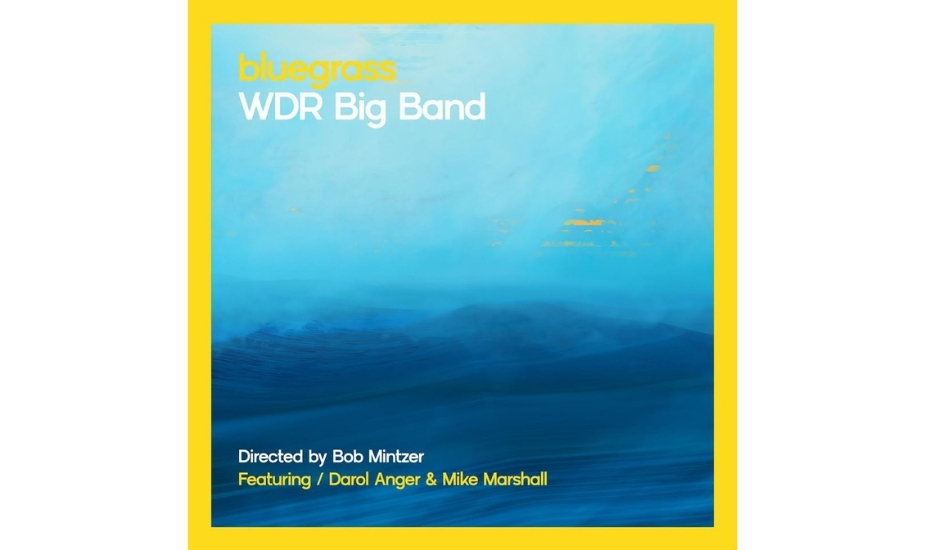
The WDR Big Band brings the best of both worlds together, with BLUEGRASS reminding us that jazz and bluegrass have more in common than we might think.
MCG Jazz
Bob Mintzer – Arrangements, Akai EWI4000s, Tenor Sax; Trumpet -Wim Both, Ruud Breuls, Andy Haderer, Martin Reuthner; Trombone – Ludwig Nuss, Tim Hepburn, Andy Hunter, Mattis Cederberg; Saxophone – Johan Hörlén, Karolina Strassmayer, Jeremy Powell, Paul Heller, Jens Neufang; Bass – John Goldsby; Drums – Dominik Raab; Piano: Billy Test; Mandolin, Guitar – Mike Marshall; Violin – Darol Anger
In 1946, the WDR Big Band got its start in Cologne, Germany—originally as a post-war radio orchestra. Same year, a little closer to the Appalachian Mountains, Bill Monroe was tightening up his band lineup to create what many now call the first true bluegrass group. With Earl Scruggs joining on banjo and Lester Flatt on guitar, Monroe’s Blue Grass Boys played a brand of string band music so driving and so distinct, it gave an entire genre its name.
So here we are, nearly 80 years later, listening to the WDR Big Band—known for its razor-sharp swing and globe-spanning jazz projects—digging into bluegrass. If you’d told Bill Monroe or one of those early radio producers in Cologne that someday a German big band would be reimagining mountain music with horns, they might’ve laughed you out of the room.
Some jazz fans still look down their noses at country or bluegrass—like those genres are somehow less sophisticated. Remember that famous spat between Buddy Rich and Charlie Daniels? Rich didn’t exactly hide his contempt for country musicians, and Daniels wasn’t having it.
But when it comes to dedication and pure skill, bluegrass players are right there with the jazz greats. Earl Scruggs didn’t stumble onto that crisp, rapid-fire three-finger banjo style by accident—he practiced relentlessly. Same kind of tunnel-vision focus you hear about with Booker Little, who put in 16 hours a day on the horn, or Sonny Rollins, who famously took his sax to the Williamsburg Bridge and played there for a year.
So doesn’t a fusion with big band jazz make perfect sense? Bob Mintzer—chief conductor of the WDR Big Band—handled the arrangements, and brought in two top-tier string players for the solo spots: mandolinist Mike Marshall and violinist Darol Anger. The result is a surprising blend of styles that works beautifully.
Darol Anger wrote ‘Emy in the Woods,’ and his violin leads the first chorus, with reeds and brass right behind him. The rhythm is the bluegrass equivalent of a shuffle beat—imagine Art Blakey’s cymbal work filtered through Appalachia and a backwoods barn dance. Andy Hunter delivers an amazing trombone solo with nothing remotely “backwoods” about it, this is jazz excellence at its best. Bob Mintzer takes a solo on his Akai EWI4000s, with the full band pushing it. Anger’s violin leads again, and as a nod to the “country” side of things, Mike Marshall’s guitar ends the piece.
On ‘Dexter,’ Mike Marshall takes off on mandolin, with Anger’s violin as partner. The band tries breaking in but the mandolin grabs another chorus. The rhythm section lays down a great shuffle beat and the full big band comes roaring back in. Billy Test delivers a fantastic piano
solo, rivaling Bob Mintzer’s tenor sax solo. Anger is back again on violin, sounding more like Stéphane Grappelli this time than Bill Monroe’s legendary fiddler, Kenny Baker.
Marshall’s mandolin takes center stage on ‘Slip and Slide, ’easily dominating the piece with its energy. Later, he rips through lightning-fast, bluesy licks that add another layer of intensity. Karolina Strassmayer’s conversational saxophone phrasing and her tone, with its hint of smokiness, are very appealing. Marshall ends the piece just as he started—with that unmistakable bluegrass shuffle beat.
The WDR Big Band brings the best of both worlds together, with BLUEGRASS reminding us that jazz and bluegrass have more in common than we might think.
