
There is a lightness and humour in the improvised lines that directly contradicts any fear that listeners might have about computers creating sterile, anodyne, homogenised sounds.
Not Applicable: not075
James Allsop: tenor saxophone, bass clarinet; Alex Bonney: trumpet, piccolo trumpet; Tim Giles: drums; Isambard Khroustaliov: electronics
Recorded by Marcus Locock and Luke Farnell at Livingstone Studio
While there are many musicians that use electronics to mix, meld, and mess with their sounds as they play, there can’t be many who are using generative artificial intelligence as the basis of the sounds to which they respond in their improvisations. As such, Scarla O’Horror are trail-blazers in according ‘robot synthesizers’ a role, albeit uncredited, in the improvising band. From the press release’s somewhat confused description of the process, the musicians improvised collectively. The improvisations were then responded to by Khroustaliov’s computers, which then contributed sounds to which the musicians responded. In this description, the computers become part of the loop through which the musicians call-and-respond. But this makes the ‘robot synthesizers’ merely a channel through which the ‘call’ is distorted prior to a ‘response’ being made, which might either delay or distort the spontaneity of the musical creation.
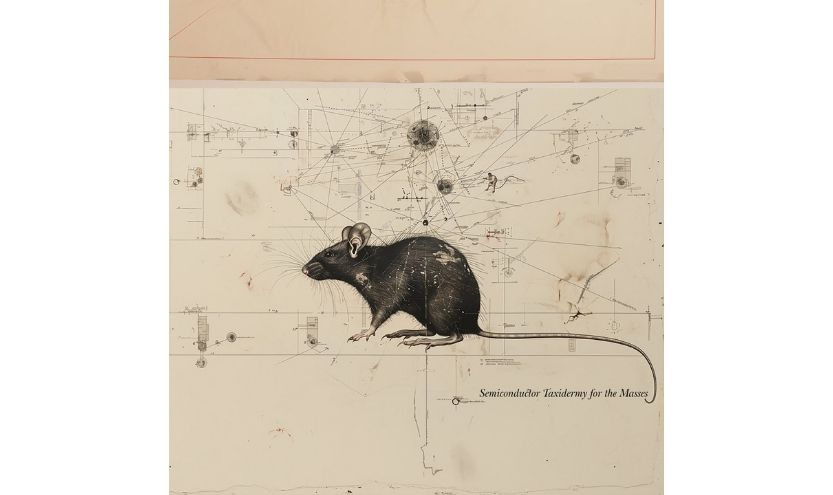
The recording has three tracks. The opening ‘Raccoon with Wound’ runs to just over 2½ minutes and serves as both an appetiser to the main tracks and an acknowledgement of jazz musicians in history who have championed the freedom of improvised music. The central track is ‘The Rats of Gillett Square’ and runs for almost 20 minutes. Readers will recognise that this refers to the location of the Vortex Jazz Club. The ‘rats’, in this case, being rodents feeding of the bins nearby. The band have drawn an analogy between their approach to musical experimentation and the scavenging rats, perhaps mutated and adapted into cyborgs (as hinted by the album title and the oddly disturbing images in the CD liner)?
While the acoustic instruments are (mostly) recognisable from their timbre, the pieces are awash with ghostly echoes of these instruments, together with the chirrups and swooshes that you might expect from electronic live mixing. I am guessing that it these echoes of instruments that the ‘robot synthesizer’ is generating and it is these that the players are merging into their own sounds. While we might have seen skilled live remixing (by musicians such as Khroustaliov), handing this to a computer feels immensely exciting, if a little trepidatious. For this to be effective, the humans in the loop need to have the confidence in their own ideas to be able to avoid blindly jumping to whatever the computer is urging, and the foresight to interpret its urgings as plausible directions to explore. For this to happen in real-time (the whole set was set up and recorded in a single day) requires musicians who know each other, know their instruments, and are brave enough to cede some control to their ‘robot synthesizer’ band-mates.
I should have begun this review by stating how fresh, spontaneous, and human the music feels. Because there is little sense in which this is anything but a very talented improvisation unit. There is a lightness and humour in the improvised lines that directly contradicts any fear that listeners might have about computers creating sterile, anodyne, homogenised sounds. I very much liked the description of Scarla O’Horror in their press release as ‘emerging (2020) from the charred remains of their time-travelling wheelie-bin’ into a present where they are ‘under attack from B-movie aliens controlled by Sun Ra’s Moog and Patrick Gleeson’s ARP 2600’. If this is a group that is fighting the intrusion of ‘AI’ into the creative industries, then we should all applaud the stance that are taking in finding ways to work with not against the on-rush of technology – and doing this in a way that preserves humanity’s dignity and sense of humour.
